Lab Onboarding Checklist for New PhD Students and Members
A lab onboarding checklist for the first day, first week and first month of a new PhD student, postdoc or visiting researcher, plus the offboarding list that keeps data and keys from walking out the door.
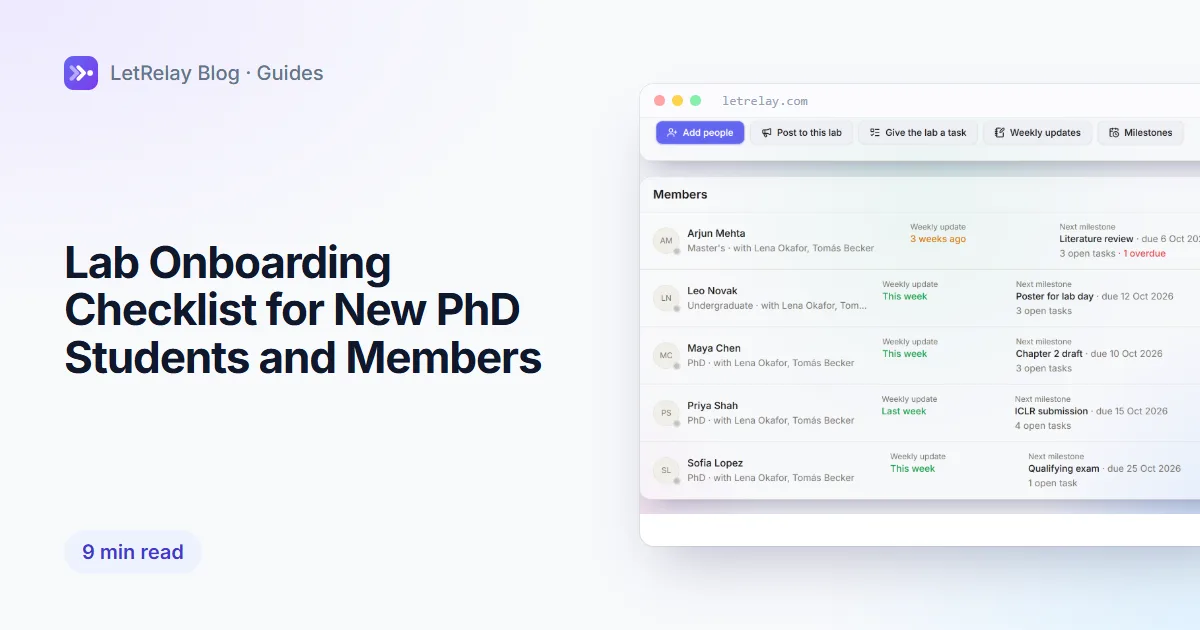
A lab onboarding checklist gets a new PhD student, postdoc or visitor from "arrived" to "doing research" without anyone forgetting a step. It covers four things in order: access (accounts, keys, compute), safety (the induction and instrument training the institution requires), the science (data, code, the lab handbook), and the people (a supervisor, a 1:1 rhythm, the group). Run it from a shared checklist, not from the PI's memory, and pair it with an offboarding list for the day they leave.
Onboarding goes wrong in small, expensive ways: a student waits two weeks for cluster access, uses an instrument before being trained on it, or never learns where the raw data is supposed to live. None of these is hard to prevent. They just need to be written down once.
Before day one
Most delays in the first month start with a request nobody sent before the person arrived.
- University account and email requested, so they can sign in on day one.
- Building access card and lab keys ordered. Security offices can take days.
- Compute and storage accounts requested: the cluster, cloud credits, shared drives.
- Desk and equipment ready: a bench or a desk, a laptop if the lab provides one.
- A named buddy in the lab, ideally a senior student or postdoc, who answers the questions people are embarrassed to ask the PI.
- The first 1:1 booked with their supervisor for the first week.
Day one
- Welcome, tour, and introductions to everyone they will work next to.
- Emergency procedures: exits, alarms, eyewash and showers, spill kits, who to call. Safety offices are explicit that emergency and general lab safety procedures are covered when a new worker starts; procedure-specific training can follow when they begin that procedure.
- Sign-in on every account that was requested, and a list of anything still missing.
- Where things live: the lab handbook, the shared drive, the code repositories, the notebook.
First week: safety and training
Institutions set the rules here, so the checklist should point to them rather than rewrite them.
- General lab safety induction through the environmental health and safety (EHS) office, plus any required online modules for the lab's hazards: chemicals, lasers, biological materials or radiation.
- Lab-specific training on the lab's own hazards and procedures. Many universities provide a template checklist for this; the usual practice is that each item is initialled and dated when covered, and that the record is kept.
- Instrument and equipment training booked for every instrument they will use, before they use it, and the rules for booking shared equipment fairly explained on the same day.
- Research ethics or responsible-conduct training if their project involves human subjects, animals, or the funder requires it.
- Occupational health clearance if the work needs it (some labs require it before any hands-on work).
Keep the training record where the lab can see it, with expiry dates. Several certificates lapse after a year or two, and a lapsed one discovered during an inspection is a much worse day than a reminder a month ahead.
First week: data, code and the way the lab works
- Read the lab handbook and data policy: where raw data goes, how files are named, what is backed up, what never leaves the institution.
- Access to the notebook (the ELN or paper notebook convention) and a first entry, even a trivial one, to learn the format.
- Access to code repositories and compute, with one small job run end to end.
- Added to the lab mailing list, chat and calendar so they see group meetings and deadlines.
If the lab has no handbook yet, the first new member is the right moment to write one. Every question they ask in week one is a missing paragraph. A short lab expectations document (meetings, hours, authorship, who does what) is the best first page, and a new member should go through it with the PI in the first week.
First month: the supervision rhythm
This is the part most onboarding checklists skip, and the part that decides whether a new PhD student settles in.
- Agree the 1:1 rhythm: weekly or fortnightly for new students, with a standing agenda.
- Start weekly updates from the first Friday. A short written update (done, next, blockers, reading) helps a new student most, because it gives them a sanctioned place to say they are stuck. The format is in the PhD weekly update template.
- Set the first milestones with dates: the first reproduction, the literature review, the qualifying exam or first-year review.
- Introduce them at group meeting and give them a slot to present, even informally, within the first two months.
- Check in on how they are doing, not only on what they are doing. The first semester is where isolation starts.
The whole weekly rhythm (updates, digest, 1:1s, milestones) is described in how to manage PhD students without chasing them.
The checklist, in one place
Copy this into whatever the lab uses:
Welcome to the lab
[ ] University account, email and Wi-Fi
[ ] Building access card and lab keys
[ ] General lab safety induction
[ ] Instrument / equipment training booked
[ ] Access to shared drives, code repositories and compute
[ ] Added to the lab mailing list and chat
[ ] Read the lab handbook and data policy
[ ] First meeting with your supervisor; agree a 1:1 rhythm
[ ] Introduce yourself at group meeting
A lab onboarding checklist template for Excel or Google Sheets
If the lab prefers a spreadsheet to a tool, use one row per task and one sheet per new member. Five columns are enough:
| Task | Owner | Due | Done on | Notes |
|---|---|---|---|---|
| University account and email requested | Lab manager | Before day 1 | ||
| Building access card and lab keys | Lab manager | Before day 1 | Security office can take days | |
| General lab safety induction | New member | Week 1 | Certificate to the lab folder | |
| Instrument training booked for each instrument | Buddy | Week 1 | Expiry date noted | |
| Read the handbook, data policy and expectations document | New member | Week 1 | Discuss with the PI | |
| Where stock, ordering and the shared inventory live | Lab manager | Week 1 | See lab inventory management | |
| First 1:1 and agreed rhythm | Supervisor | Week 1 | ||
| First weekly update written | New member | First Friday | ||
| First milestone dated | Supervisor | Month 1 |
Use the "Due" column in relative terms (before day 1, week 1, month 1) so the same sheet works for every new member: copy the sheet, add the start date, and sort by due. Keep the sheet in one place the lab manager and supervisor can both see, and file the finished copy with the member's training record.
Offboarding: the list for the day they leave
A lab loses more on the way out than on the way in. Datasets end up on a personal laptop, the only copy of an analysis script leaves with its author, and keys are never returned.
Leaving the lab
[ ] Return keys, access card and borrowed equipment
[ ] Hand over data, code and notebooks (with a README)
[ ] Archive raw data where the lab keeps it
[ ] Transfer or close accounts and cloud resources
[ ] Update the publications list and author contacts
[ ] Exit meeting with the PI
[ ] Add alumni contact details
Start it a month before the leaving date, not in the last week. The README for data and code is the item most often skipped and most often regretted a year later, when a reviewer asks for a rerun. The same discipline applies in companies; the employee offboarding checklist covers the access side in more depth.
Visiting researchers and undergraduates
Short stays need a shorter list, not no list. Keep the safety induction, the instrument training, data policy and a named contact; drop the milestones and long-term accounts. Set an end date on every account at creation, so access expires on its own when the visit ends.
How LetRelay does it
A LetRelay research group comes with both lists above as editable templates, "Welcome to the lab" and "Leaving the lab". Training certificates are stored per person with expiry dates, and the lab's equipment can be booked within limits you set for each resource. Add a new member from Research, then People, with their level, dates and supervisor in one step, and they get their sign-in by email. See LetRelay for research groups.
FAQ
What should be on a lab onboarding checklist?
Access (university account, keys, compute and storage), safety (the institution's induction plus lab-specific and instrument training), the science (the lab handbook, data policy, notebook and repositories) and the people (a buddy, the first 1:1, a supervision rhythm and an introduction at group meeting).
Who is responsible for lab safety training of a new student?
The institution's safety office sets the required training, and the PI or lab supervisor is responsible for making sure each new member completes it and receives lab-specific training for the hazards in their work. Keep a dated record of what was covered.
How long should onboarding a new PhD student take?
Access and safety should be done in the first week. Getting productive takes longer: plan the first month around one small end-to-end task, weekly updates and regular 1:1s, with the first real milestone set within the first two or three months.
What is the most forgotten step when someone leaves a lab?
Handing over data and code with a README that explains where everything is and how to rerun it. Returning keys is usually remembered; documenting the analysis usually is not.
Should onboarding differ for postdocs and PhD students?
The access and safety parts are the same. Postdocs usually need less on the supervision rhythm and more on the lab's operations, since they often end up training the students who arrive after them.
Is there a free lab onboarding checklist template I can copy?
Yes: the checklist above works as plain text, and the table in the template section above works in Excel or Google Sheets (task, owner, due, done on, notes). Copy it per new member, add their start date, and keep the finished copy with their training record. Adjust the safety rows to your institution's rules.
Who should run the onboarding checklist in a lab?
The PI owns it, but one person should run it day to day: usually the lab manager, or a named buddy for a small lab. Give each row an owner. Items without an owner are the ones that get missed, such as the data README or the instrument sign-off.
Sources
Building LetRelay, the workspace for research groups and small teams: lab management, supervision tools, and an internal request desk with AI triage and SLA tracking.
Run your research group on LetRelay
Tasks, deadlines, weekly updates and supervision in one place, so you stop chasing students for news. Free for up to 5 people.
Keep reading
Lab Inventory Management: Spreadsheet Template and Tools
The columns a lab inventory spreadsheet needs, how to set reorder levels, a simple ordering workflow, and when to move to free or paid inventory software.
New PI Checklist: Setting Up Your Lab in Year One
A phase-by-phase checklist for new faculty: the offer letter, before you arrive, the first month, the first term and year one, plus the systems to set up early.
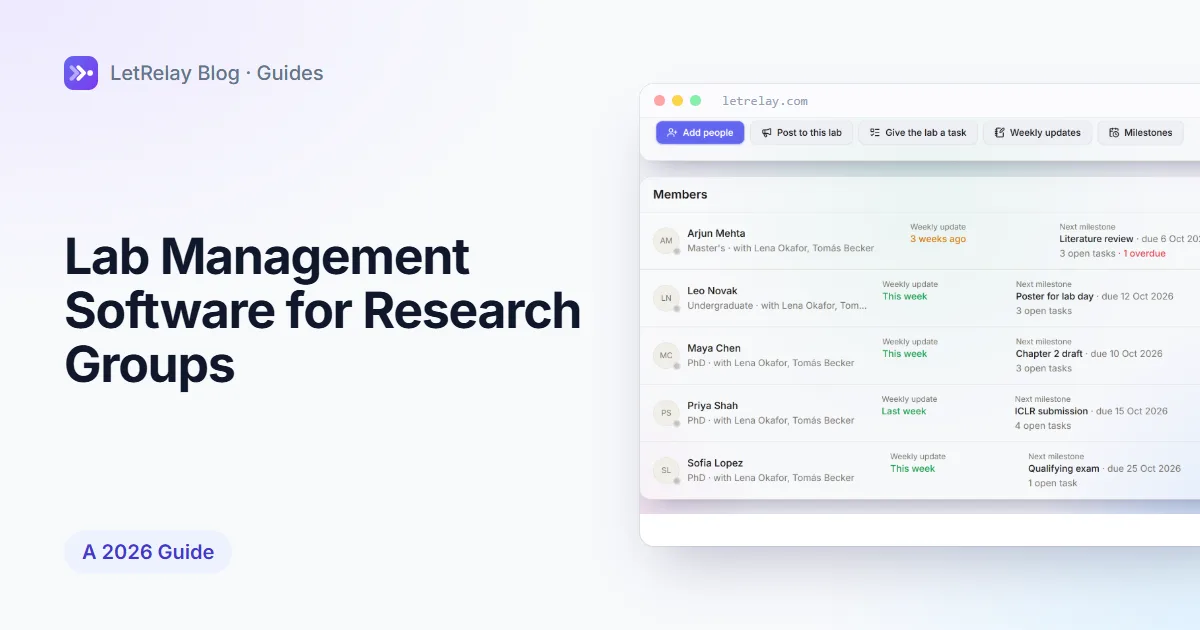
Lab Management Software for Research Groups: A 2026 Guide
Lab management software is really four kinds of tool: notebooks, sample systems, inventory and ordering, and group management. Here is what each does, the names PIs actually use, and how to pick a stack for a small academic lab.